
Prepared by Mohammed Qassem
November 25, 2026
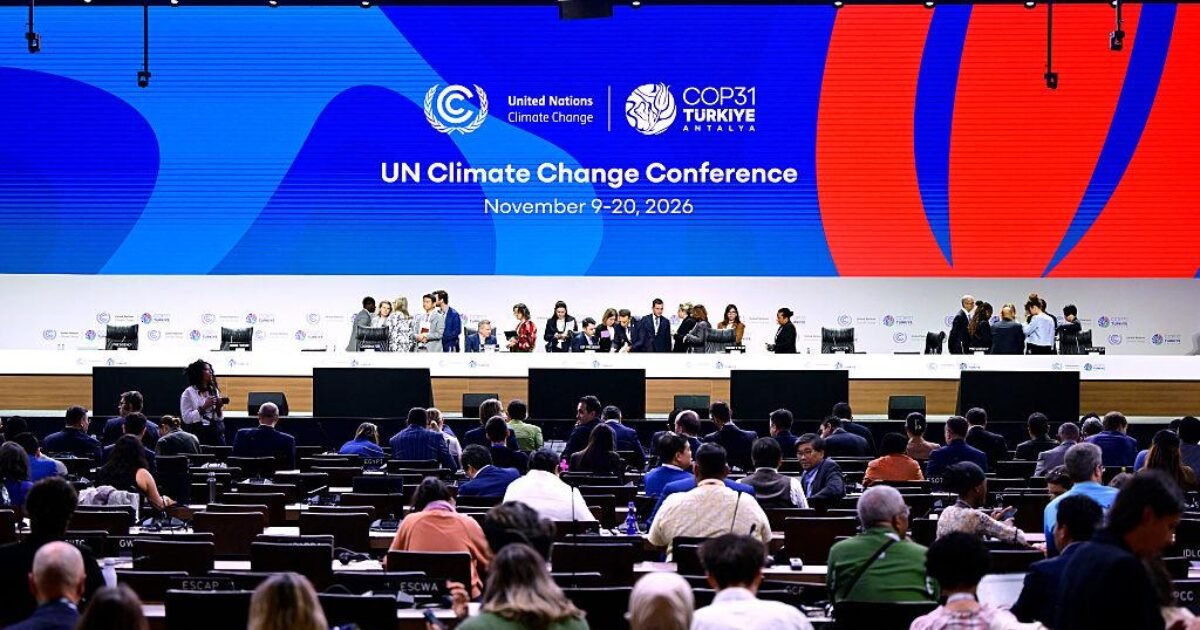
The United Nations climate conference COP31 concluded in the Turkish city of Antalya without reaching a final political agreement, in a development that reflects widening international divisions over the future of fossil fuels and financing the climate transition.
After two weeks of negotiations and additional sessions that extended beyond the scheduled deadline, participating countries failed to overcome disagreements over the wording of commitments on coal, oil and gas, turning the summit into a fresh test of the international system’s ability to manage one of the most serious cross-border crises.
United Nations Secretary-General António Guterres described the outcome as disappointing, warning that the absence of political consensus does not change the scientific facts about accelerating global warming.
First: Why did the negotiations fail?
The disagreement was not about the scientific diagnosis of the climate crisis, but about how to distribute the economic and political burdens of addressing it.
Three main areas of disagreement emerged:
1. The future of oil, gas and coal
Countries and environmental groups called for stronger commitments to transition away from fossil fuels, while countries whose economies rely heavily on oil and gas production opposed more stringent language.
This confrontation shows that the climate transition is no longer merely an environmental issue; it has become directly linked to energy security, government revenues, jobs and investment.
2. Financing for developing countries
Countries most exposed to climate change are calling for greater financing to address droughts, floods, rising sea levels and infrastructure destruction.
But disagreements over the scale, sources and distribution mechanisms of that financing remain among the biggest obstacles to international consensus.
3. Carbon removal technologies
Disagreements emerged over the role of carbon capture and removal technologies.
While some countries consider them part of the solution, others fear they could become a justification for continuing fossil fuel production instead of reducing emissions at their source.

Second: Did the summit fail completely?
Despite the absence of a final political agreement, it would be inaccurate to say the conference achieved no results.
According to Reuters, participating countries adopted 46 decisions on various issues, and progress was made on a just transition package and electricity initiatives, while previous commitments to transition away from fossil fuels were maintained.
Herein lies the paradox: countries were able to make progress on technical and implementation issues, but failed to agree on the overarching political message that was supposed to guide the next phase.
Third: Oil versus economic transition
The outcome of COP31 reveals a strategic dilemma facing the global economy.
Fossil fuel-producing countries do not view a rapid move away from oil and gas as merely an environmental decision, but as a transition that could affect their public revenues, geopolitical influence and industrial stability.
Mean while, energy-importing countries seek to reduce their dependence on foreign markets and diversify supply sources, making investment in renewable energy part of their national security policies as well.
Thus, the struggle over the future of fossil fuels is also a struggle over the distribution of economic power in the international system.
Fourth: Who pays the price for the failure to reach consensus?
Developing countries, small islands and regions with weak infrastructure will be among those most exposed to the consequences of continued rising temperatures.
The failure to agree on a new political framework also weakens the ability to coordinate international financing and accelerate climate projects.
But previous commitments and agreements are not nullified by COP31’s failure to reach an agreement, and the summit’s failure does not mean the Paris Agreement is canceled or previous pledges are ended.
Fifth: COP32 faces a tougher test
Attention is now turning to Addis Ababa, Ethiopia, where COP32 is scheduled to be held in 2027.
The next conference will face a test that goes beyond producing closing statements: it must turn previous commitments into financing and projects that can be measured and implemented.
It will also have to address the disagreements left unresolved in Antalya, particularly over fossil fuels, financing for developing countries and the credibility of climate transition mechanisms.
Strategic conclusion
The failure of COP31 was not merely a diplomatic setback, but a reflection of clashing major economic interests.
The world wants to reduce emissions, but it still depends on the energy sources that produce most of them. Countries are calling for a transition, but disagree over who will pay for it and who will bear the losses of the transition period.
The Antalya summit showed that the climate crisis is no longer merely an environmental crisis, but a test of the balance of power, wealth and energy in the international system.