
Get stories like this delivered straight to your inbox.Sign up for The 74 Newsletter
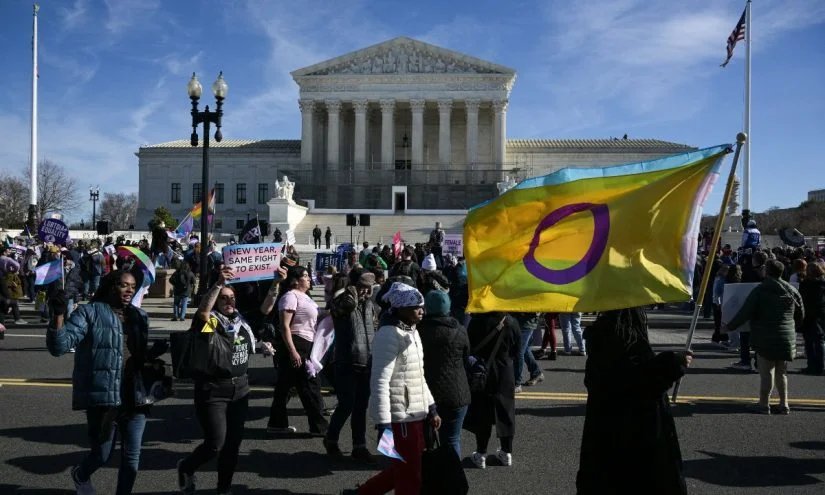
The U.S. Supreme Court on Tuesday appeared to support allowing states to decide whether to ban transgender athletes from competing in girls’ and women’s sports — an issue that has dominated the Trump administration’s education policy for the past year.
In two separate cases, attorneys for track athletes from Idaho and West Virginia argued that such restrictions violate trangender students’ constitutional right to equal protection under the law. They say that through medication, these athletes have reduced any sex-based physical advantages that would create unfair competition. The West Virginia case also questions whether the state’s ban violates Title IX’s right to equal educational opportunities for women and girls.
West Virginia’s law treats Becky-Pepper Jackson, a transgender 10th grader, “differently from other girls on the basis of sex,” Joshua Block, an American Civil Liberties Union attorney, told the court. The Bridgeport High School student, he said, took puberty blockers and went through “female puberty.” It’s “absolutely reasonable,” for states to separate teams based on a biological definition of sex, he said, but argued that the states’ position is “invalid as applied to a discrete subset” of people who have mitigated physical advantages.
to و the و that – تفاصيل مهمة
But the conservative justices seemed reluctant to carve out an exception for trans students, even those who have taken steps to reduce any competitive advantage.
“If we adopted that, that would have to apply across the board and not simply to the area of athletics,” Chief Justice John Roberts said.
The court’s decision in the case could impact all 27 states with similar laws that prohibit trans girls from competing on teams consistent with their gender identity.
Upon taking office, President Donald Trump moved aggressively to place restrictions on trans athletes and highlight the experiences of those who said they were either injured by a trans competitor or put at a competitive disadvantage. Through executive order, he said Title IX only applies to cisgender women and girls, while the Department of Justice is now suing California and Maine over allowing trans students to compete on teams consistent with their gender identity.
LGBTQ advocates want the court to base its decision on the 2020 majority opinion inBostock v. Clayton Countyin which the court found that transgender employees are a protected class in the workplace.
“This is unfair to me and every transgender kid who just wants the freedom to be themselves,” Pepper-Jackson said in a recorded message last week. “I’ve had my rights and my life debated by politicians who’ve never even met me.”
Education Secretary Linda McMahon, who attended the than three hours of oral arguments, discussed the stakes for many women outside the court.
the و in و to – تفاصيل مهمة
“Americans have had enough of women and girls losing opportunities and being subjected to the indignity and danger of unfair competition due to the left’s warped application of federal law,” she said.
The department pressured the University of Pennsylvania, for example, to no longer allow trans women to compete on women’s teams. As part of a resolution agreementthe university erased trans swimmer Lia Thomas’ records and issued apologies to swimmers who lost to her.
Attorney Kathleen Hartnett, who represents Boise State University student Lindsay Hecox, who takes drugs to suppress testosterone, told the court that some trans students might even be at a disadvantage. They have “this larger frame with weaker muscles and no testosterone,” she said.
But conservative advocates disagree.
to و the و of – تفاصيل مهمة
“Physiologically, males have a larger heart, lungs, bone mass, muscle mass and are taller than females,” Beth Parlato, senior legal counsel at the conservative Independent Women’s Law Center, told The 74. “It is undisputed that males retain significant physical advantages over females, making sex-based categories essential to fairness and safety in women’s sports.”
‘Treated as individuals’
Inside the court, Hashim Mooppan, principal deputy solicitor general, argued for the Trump administration, saying that denying a “special accommodation” to a trans woman or girl is not discrimination.
But Justice Ketanji Brown Jackson, one of the liberal justices, questioned why Hecox didn’t have a claim.
the و a و for – تفاصيل مهمة
“In equal protection law,” she said, “We say all the time things like ‘People need to be treated as individuals and not as just as members of a group.’ ”
Justice Brett Kavanaugh, one of the six conservatives on the court, said he “hates” that trans students might be denied an opportunity to participate in sports. He also questioned whether it’s right to “constitutionalize a rule for the whole country” when the science is still evolving.
But making a team or a starting lineup is a “zero-sum game,” he said. “Those things matter to people, big time.”
Observers believe the outcome could rest on how either Roberts or Justice Neal Gorsuch, who wrote theBostockdecision, rule. During Tuesday’s back-and-forth, Gorsuch asked whether transgender status could be considered an “insular class,” considering the history of discrimination against them. But he joined the majority opinion that allowed Tennessee to restrict gender-affirming care for minors.
the و to و a – تفاصيل مهمة
‘Not going to be satisfied’
The court heard the arguments in the same week the U.S. Court of Appeals for the Eighth Circuit is set to take up another federal case involving trans athletes. Female Athletes Uniteda nonprofit that opposes trans students participating in women’s sports, sued Minnesota officials over the state’s policy allowing athletes to compete on teams based on their gender identity.
“Their argument is that Title IX demands exclusion of trans athletes from girls’ teams, which is not going to be our position,” said Brian Dittmeier, director of LGBTQI+ Equality at the National Women’s Law Center, which filed a brief in support of Minnesota.
The decision in the Eighth Circuit case, he said, is likely to come before the Supreme Court rules in the Idaho and West Virginia lawsuits, and could “inform the narrative” in future cases. The Female Athletes United lawsuit, he said, shows that those opposed to allowing trans athletes to compete with women are “not going to be satisfied with a compromise of letting the states decide.”
Did you use this article in your work?
the و to و in – تفاصيل مهمة
We’d love to hear how The 74’s reporting is helping educators, researchers, and policymakers.Tell us how
Disclaimer: This news article has been republished exactly as it appeared on its original source, without any modification. We do not take any responsibility for its content, which remains solely the responsibility of the original publisher.
Author:Linda Jacobson
Published on:2026-01-14 01:42:00
Source: www.the74million.org
Disclaimer: This news article has been republished exactly as it appeared on its original source, without any modification.
We do not take any responsibility for its content, which remains solely the responsibility of the original publisher.
Author: uaetodaynews
Published on: 2026-01-14 06:45:00
Source: uaetodaynews.com