
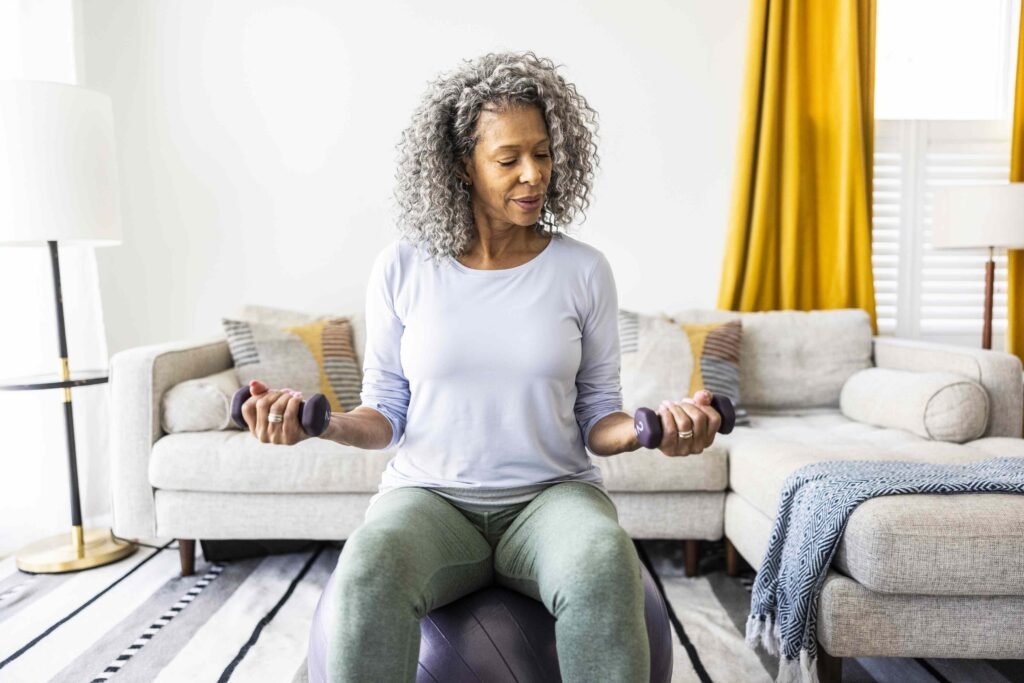
Research shows that it’s possible for people over the age of 50 to improve upper-body strength while sitting in a chair.
Whether you’re dealing with an injury or mobility limitations, or you’re just looking for ways to stay active at your desk, consider incorporating these chair exercises for arms into your movement routine.
for و to و you’re – تفاصيل مهمة
Mobility exercises, such as arm circles, have been shown to improve joint range of motion, posture, and body awareness.Beginning your upper-body chair workout with arm circles will warm up your body’s tissues and help you do the following arm exercises with proper form.
- Sit up straight with your shoulders back, core engaged, arms at your sides, and feet flat on the floor.
- Keeping your elbows straight, raise your arms to shoulder height, out to the sides.
- Slowly circle your arms to the front (imagine tracing dinner plate-sized circles with your fingertips) for 30 seconds.
- Reverse the motion and circle your arms backward for 30 seconds.
- Do three sets of 30 seconds of circles in each direction, resting for up to one minute between sets.
*Note: The above demo shows this movement in a standing position, but it can also be done while sitting.
your و to و the – تفاصيل مهمة
The biceps curl is a classic arm exercise for a reason: it works. A recent study found that, compared to the dumbbell row (another upper-body workout staple), the biceps curl was associated with greater increases in muscle mass.
- Sit up straight with your shoulders back, core engaged, and feet flat on the floor.
- Holding a dumbbell in each hand, allow your arms to hang at your sides, palms facing forward.
- Keeping your elbows close to your torso, use your biceps (the muscles on the front of your arms, between your elbows and shoulders) to draw both dumbbells up toward your shoulders.
- Slowly lower the weights to the starting position. Repeat for a total of 12 reps.
- Do three sets of 12 reps, resting for up to two minutes between sets.
The overhead press, which engages the shoulders, biceps, triceps, and forearm muscles, is one of the most functional lifts you can perform.
Dozens of everyday movements, from placing pantry items on a high shelf to storing your luggage in a plane’s overhead compartment, require the strength and coordination to press an external load overhead.
your و the و to – تفاصيل مهمة
- Sit up straight with your shoulders back, core engaged, and feet flat on the floor.
- Hold a dumbbell in each hand in front of your shoulders, palms facing each other.
- Press both hands directly overhead until your elbows are fully extended.
- Slowly lower the weights to the starting position. Repeat for a total of 12 reps.
- Do three sets of 12 reps, resting for up to two minutes between sets.
*Note: The above demo shows this movement in a standing position, but it can also be done while sitting.
Strong, well-developed triceps add shape and definition to the back of your arms, but they’re also crucial to activities that require pushing, lifting, and stabilizing the shoulder and elbow joints.
This extension exercise engages the triceps in an overhead position, which has been found to be effective at building muscle mass than a neutral position, in which you’re pushing down against the resistance.
the و and و to – تفاصيل مهمة
- Sit up straight with your shoulders back, core engaged, and feet flat on the floor.
- Hold a dumbbell in each hand in front of your shoulders, palms facing each other.
- Press the weights directly overhead until your elbows are fully extended, then draw the weights together so they’re touching. This is the starting position.
- Keep your neck, shoulders, and torso stationary as you slowly bend your elbows to lower the weights behind your head.
- Keeping the dumbbells pressed together, straighten your arms to lift the weights overhead. Repeat for a total of 10 reps.
- Do three sets of 10 reps, resting for up to two minutes between sets.
- Pick the right chair:Sit in a stable, stationary chair. If your chair has wheels, ensure they can be locked in place so your chair doesn’t shift or roll with your movement. Avoid plush seat cushioning, which can create instability and negatively impact your posture. If possible, use a chair without armrests, as they can limit your mobility.
- Start with lighter weights:Even if you think you can go heavier, do the first set of any new exercise with a relatively light load. This will allow you to practice proper form and, if necessary, adjust to performing a familiar standing exercise from a seated position.
- Keep your core engaged:Begin every exercise with good posture (shoulders back, chin parallel to the ground, and rib cage stacked over hips), and an engaged core. To engage your core, think about bracing your abdominal muscles to absorb a punch to the stomach. Activating your core keeps you stable as you move your arms and prevents your lower back from arching and your shoulders from slouching forward.
- Avoid relying on momentum:Rocking, jerking, and twisting in your seat introduces momentum, which only robs you of the full benefits of the exercise. To fully engage the muscles in your arms and shoulders (and reap all the strength-building benefits), keep your torso as immobile as possible while doing arm exercises.
Disclaimer: This news article has been republished exactly as it appeared on its original source, without any modification.
We do not take any responsibility for its content, which remains solely the responsibility of the original publisher.
Author:Jenessa Connor, NASM-CPT
Published on:2026-01-11 19:00:00
Source: www.health.com
Disclaimer: This news article has been republished exactly as it appeared on its original source, without any modification.
We do not take any responsibility for its content, which remains solely the responsibility of the original publisher.
Author: uaetodaynews
Published on: 2026-01-12 06:37:00
Source: uaetodaynews.com