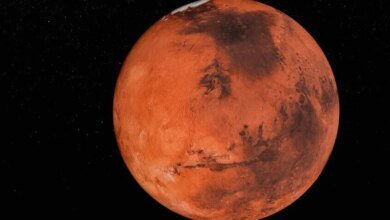
A Time Mystery On Mars Solved By Einsteins Theory!


Due to the influence of the theory of general relativity, it turns out that one day on the Red Planet is shorter by 477 millionths of a second (0.000477 seconds) per day on Mars, compared to our day on Earth.
Although this difference seems very small, it has important practical implications for the future of space exploration.
This time difference is mainly due to two factors: The first is the weakness of gravity on the surface of Mars compared to Earth, as its strength is about one-fifth of the gravity on our planet. The second factor is the shape of Mars’ elliptical orbit around the sun, and its changing speed depending on its distance or proximity to it.
These factors combined make time advance quickly on Mars when observed from Earth.
It is worth noting that this difference is not completely constant, but rather changes slightly depending on the relative positions of Earth and Mars in their orbits. The difference may increase or decrease by up to 0.000226 seconds, but the average remains at that exact number that scientists have arrived at.
This discovery has great practical importance for the future, especially with regard to the precise navigation systems that will be used on the surface of Mars, communication networks between the two planets, and future manned missions. Modern technologies such as global positioning systems and fifth-generation communications networks require very precise synchronization, and their performance may be affected by time differences smaller than those discovered between Earth and Mars.
This calculation was made by a research team from the National Institute of Standards and Technology (NIST) in the United States, who took into account precise measurements of Mars’ orbit, its gravitational force, and the gravitational effects of the Sun, Moon, and Earth.
This study is an extension of previous research conducted by the same team to calculate the time difference between the Earth and the Moon, which turned out to be 0.000056 seconds.
It is important to emphasize that future astronauts on Mars will not notice this time difference in their daily experience, as a second remains a second from their personal perspective. But when comparing Martian clocks with Earth clocks, this subtle difference will become clear. Here lies the need to understand this difference and take it into account in coordinating operations on the two planets.
This study shows how a deep understanding of fundamental physical laws, such as Einstein’s theories, has become an integral part of planning space exploration. What seemed in the past to be purely theoretical concepts, today have become the basis for developing technologies that will enable humanity to expand its presence in the solar system.
Source: Space
Disclaimer: This news article has been republished exactly as it appeared on its original source, without any modification. We do not take any responsibility for its content, which remains solely the responsibility of the original publisher.
Author:
Published on:2025-12-03 21:44:00
Source: arabic.rt.com
UAETodayNews delivers the latest news and updates from the UAE, Arab world, and beyond. Covering politics, business, sports, technology, and culture with trusted reporting.
Disclaimer: This news article has been republished exactly as it appeared on its original source, without any modification. We do not take any responsibility for its content, which remains solely the responsibility of the original publisher.
Author: uaetodaynews
Published on: 2025-12-04 00:50:00
Source: uaetodaynews.com