

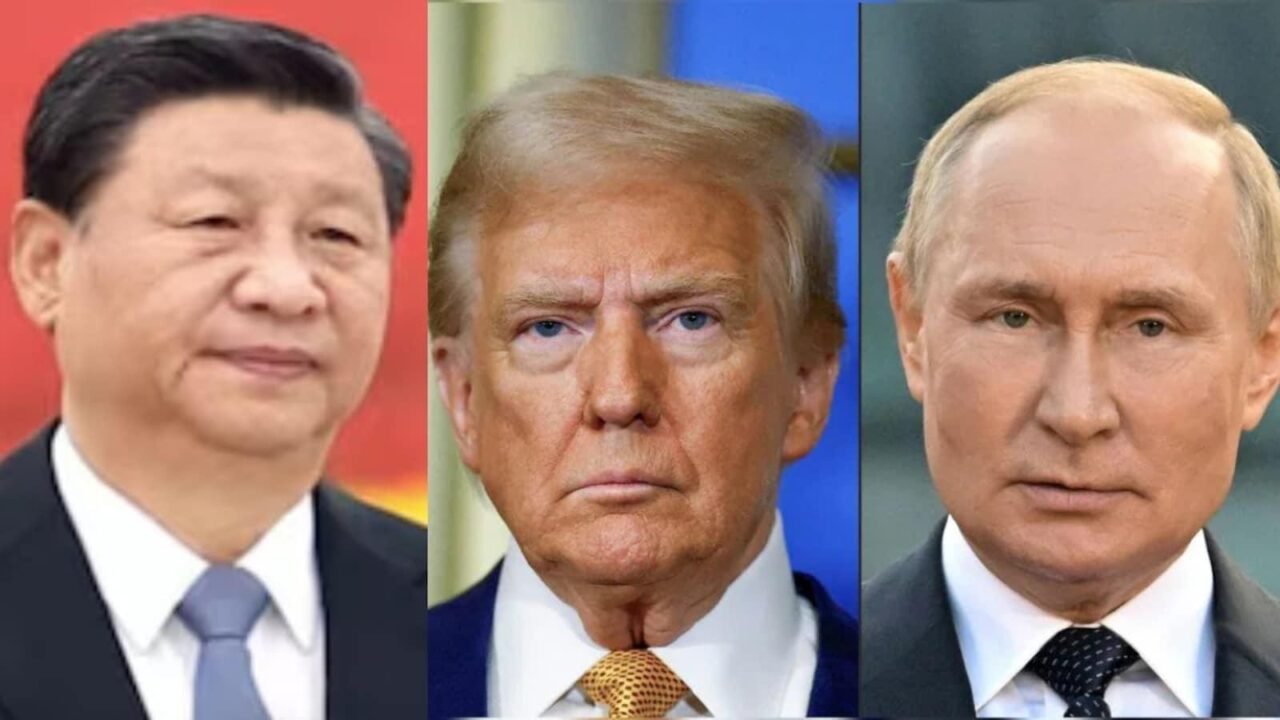
Bilateral talks precede the trilateral meeting
The Shenzhen meeting followed a flurry of diplomatic activity, most notably a bilateral meeting between Trump and Xi Jinping, their third this year. It lasted more than an hour and covered economic, trade and technological ties between the two countries.
The Chinese president’s opening remarks signaled a desire to build a stable relationship with Washington based on mutual respect, fairness and reciprocity, while Trump described his relationship with his Chinese counterpart as special and voiced optimism that the talks could yield positive results.
Trump also held a separate meeting with Putin that lasted about 40 minutes, their first direct talks since they met in Alaska last year and failed to reach a settlement to the war in Ukraine.
These bilateral meetings s how that the trilateral summit is more than a group photo: It follows separate efforts by Washington to open negotiating channels with Beijing and Moscow.
First: Ukraine — Washington wants peace, but the terms are complicated
Russia’s war in Ukraine is central to the summit’s calculations, even if it is not explicitly on the official agenda.
The U.S. president is seeking to present himself as capable of ending the war and securing a settlement that would stop the drain on military and economic resources and ease domestic political pressure on his administration.
The difficulty lies in finding terms that both Moscow and Kyiv could accept.
Russia wants to consolidate its battlefield gains, secure guarantees about Ukraine’s future security arrangements and curb the eastward expansion of the North Atlantic Treaty Organization (NATO). Ukraine, in turn, insists on its right to defend its territory and sovereignty and rejects any settlement that would force it to give up territory.
Abu Dhabi hosted direct talks between Russian and Ukrainian representatives on November 10 and 11, with U.S. diplomatic support, in the first direct negotiations of their kind since February, according to published reports.
That raises a fundamental question: Can Trump persuade Putin to accept an acceptable settlement, or might Washington have to make concessions involving Ukrainian territory or Kyiv’s future relationship with NATO?
The issue is all the more sensitive because Ukraine and European countries have no seat at the trilateral table, even though any agreement on the future of European security would directly affect them.
Any U.S.-Russian understanding that lacks Ukrainian and European approval could therefore become a new source of tension rather than a step toward peace.
Second: Iran — the most sensitive issue for the Middle East
The Shenzhen summit cannot be separated from the U.S.-Israeli war against Iran, which began in February 2026 and has caused regional turmoil and affected energy markets and international shipping.
Washington recognizes that any long-term settlement with Tehran cannot rely solely on military and economic pressure, and that the positions of China and Russia will help determine how much room Iran has to maneuver.
According to published analyses, the U.S. administration wants to use Beijing’s ties with Tehran to press for concessions, particularly on the nuclear program and regional tensions.
But China does not necessarily appear ready to take on the role of direct mediator in the conflict.
Beijing has economic and strategic ties with Iran, but it is also keen to avoid an open confrontation with the United States, particularly because secure energy supplies are vital to its economy.
Russia has different calculations. It does not want to lose its influence in the Middle East and does not appear ready to give up the leverage it gains from its ties with Tehran.
One of the main sticking points in U.S.-Iranian negotiations is which issues to address first: Should the talks begin with the crisis in the Strait of Hormuz and financial incentives for Iran, or with the nuclear program and related guarantees?
This is more than a procedural dispute. It reflects a fundamental disagreement over what the settlement should look like.
The Strait of Hormuz — where politics and energy meet
The Strait of Hormuz is particularly important to all three leaders because of its vital role in the global flow of oil and gas supplies.
Any prolonged disruption to shipping through the strait would affect not only Gulf countries and Asian consumers but also Europe and global markets through higher energy prices, freight rates and insurance costs.
During his meeting with Xi, Trump stressed the importance of keeping oil flowing through the Strait of Hormuz, a sign that energy security is central to U.S.-China talks.
If the summit succeeds in easing tensions over Iran, the economic effects could extend beyond the Middle East. If it makes no progress, uncertainty in energy markets will persist.
Third: Nuclear weapons — is a new era of arms control beginning?
Nuclear arms are among the main issues Trump wants to raise as he seeks a new understanding among the United States, Russia and China.
The initiative comes at a particularly sensitive time, after the U.S.-Russian New START treaty expired in February 2026. The treaty placed limits on the two countries’ strategic nuclear arsenals.
The difficulty is that Washington and Moscow have nuclear arsenals far larger than China’s.
According to estimates reported by The Associated Press, China has more than 600 nuclear warheads, while the United States and Russia are each believed to have more than 5,000.
That gap makes Beijing reluctant to enter an agreement that would subject it to limits similar to those imposed on the two larger nuclear powers.
China argues that imposing equal limits on countries with vastly different arsenals would not necessarily be fair, while Washington maintains that any new nuclear agreement would fall short without China.
Russia, for its part, wants to maintain its position as one of the two largest nuclear powers and prevent any new arrangements from reducing its strategic capabilities.
A comprehensive agreement at a single meeting therefore looks unlikely, but even an agreement to launch a new round of negotiations could be a significant step.
Fourth: The economic and technological war between Washington and Beijing
Beyond military issues, the economic relationship between the United States and China is one of the summit’s main topics.
The two countries have the world’s largest economies, but their relationship has seen sharp trade disputes in recent years, with both sides using tariffs, export restrictions and supply chains as tools of political and economic pressure.
At the height of the dispute, U.S. tariffs on Chinese goods reached 145 percent, while Beijing responded with tariffs of 125 percent on U.S. goods, before the two sides reached a trade truce in October 2025.
But the truce does not mean the dispute is over.
The interim trade agreement was extended until January 10, 2027, to allow for broader negotiations, while rare earth minerals, semiconductors and advanced technology remain major points of contention.
Rare earth minerals are important because they are used to make smartphones, electric vehicles, military equipment, aircraft and advanced technology systems.
According to data from the Center for Strategic and International Studies cited by Al Jazeera, Chinese rare earth exports to the United States remain about 75 percent below normal levels.
That gives Beijing significant leverage over global supply chains, while Washington can exert pressure of its own through advanced technology, semiconductors and restrictions on Chinese companies’ access to certain U.S. technologies.
Artificial intelligence — the next battleground
Competition between the United States and China is no longer confined to traditional trade or defense industries.
Artificial intelligence has become one of the most important areas of competition for economic, military and strategic advantage.
Washington recognizes that its lead in manufacturing advanced processors and computing systems gives it a significant advantage in developing AI models, while Beijing is seeking to reduce its dependence on Western technology and build an independent industrial and technological ecosystem.
This competition is tied to U.S. restrictions on exports of advanced chips to China and Chinese restrictions on exports of certain critical minerals.
Any understanding between Trump and Xi on technology could therefore have far-reaching effects on the future of global technology companies, investment, data centers and AI-related industries.
Fifth: Putin and Xi — a strategic partnership with distinct priorities
Russia and China enter the summit with a strategic relationship that has strengthened in recent years, particularly in the wake of the war in Ukraine and the Western sanctions imposed on Moscow.
China has become Russia’s leading trading partner, and the Chinese market has grown more important for Russian energy exports.
Russian oil exports to China rose 35 percent in the first quarter of 2026, according to figures from a Kremlin official cited by Al Jazeera.
But the relationship does not mean their interests align on every issue.
Russia needs Chinese markets as well as economic and trade support, while Beijing benefits from Russian energy supplies and seeks to strengthen its international standing without bearing the costs of a direct confrontation with the West.
China appears more interested in building long-term influence, while Russia is pursuing more immediate political and security gains.
That difference explains why Moscow and Beijing may agree on the need to build a multipolar international order without necessarily adopting the same strategy to achieve it.
Sixth: Are we seeing a new Yalta?
The summit has drawn comparisons with the Yalta Conference in February 1945, which brought together the leaders of the United States, Britain and the former Soviet Union to shape the international order after World War II.
But that comparison calls for considerable caution.
At Yalta, the three powers were allies in the same world war and faced the task of reorganizing Europe and the world after the defeat of Nazi Germany.
In Shenzhen, the three leaders are not meeting as members of a single alliance. They represent countries competing for influence, interests, markets, technology and spheres of influence.
Today’s issues are also more complex than simply dividing up spheres of influence: They involve nuclear weapons, artificial intelligence, energy, trade, cybersecurity and military alliances.
Analysts say the meeting does not yet amount to a comprehensive plan to redraw the world’s divisions, and expectations for major breakthroughs remain low.
Its significance, however, lies in showing that Washington, Beijing and Moscow now have little choice but to deal directly with one another, however sharp their differences.
Seventh: What does it mean for the Middle East and Lebanon?
The summit’s implications extend beyond relations among the three countries to the Middle East, which has become one of the main arenas of competition among international powers.
Any U.S.-Chinese-Russian understanding on Iran could affect the level of military escalation, the security of shipping in the Gulf, the future of oil markets and relations among countries in the region.
Lebanon is affected by these developments because its security and stability are tied to regional and international balances of power.
If the major powers succeed in de-escalating tensions, risks across the region could recede and economic conditions could improve in areas such as energy prices, shipping and investment.
But if the disputes remain unresolved and military confrontations continue, Lebanon could feel the indirect effects through higher energy and import costs or greater political and security pressures in the region.
Most importantly, any regional settlement that fails to account for the interests of the countries directly affected by the crises may remain fragile, even if the major powers endorse it.
Conclusion: A summit to test where interests align, not to announce an alliance
The Shenzhen summit brings together three leaders with enormous power to shape the global economy, security and politics, but it does not necessarily bring together three allies pursuing the same goal.
Trump wants political, economic and security achievements he can point to as successes for his diplomacy. Putin wants to break Russia’s isolation, cement its place in international affairs and gain more room to maneuver on Ukraine. Xi Jinping seeks to protect China’s interests and strengthen its position as a global power that cannot be sidelined in any new world order.
The real measure of the summit’s success will therefore not be the photographs, handshakes or friendly statements, but whether it lays the groundwork for negotiations that can deliver results on Ukraine, Iran, nuclear weapons and global trade.
What the world needs is not so much a photograph of three presidents as agreements that prevent wars, curb the arms race and protect the global economy.
Perhaps the most important message from Shenzhen is that the international order is no longer shaped by the will of a single power. But the shift to a multipolar world does not necessarily make it more stable.
Editor’s note: This report was prepared using information published on the morning of Thursday, November 19, 2026. The bilateral meetings between Trump and Xi and between Trump and Putin had taken place, but the final outcome of the trilateral meeting had not yet been announced when the report was prepared.
International sources:
-
The Associated Press – Nuclear issues and the wars in Iran and Ukraine
-
Al Jazeera – What do Trump, Putin and Xi want from the Shenzhen summit?
-
CNA – Trump and Xi’s meeting in Shenzhen
-
Al-Araby Al-Jadeed – Shenzhen summit: Different priorities and low expectations


